Fastroute Benchmarks & Methodology
End-to-end results across 145 real KiCad boards in four public suites plus
native 2–16 layer stackup verification. Every output is imported back into stock KiCad and
graded by kicad-cli pcb drc --severity-error — showing both where Fastroute wins
and where rival routers still beat it today.
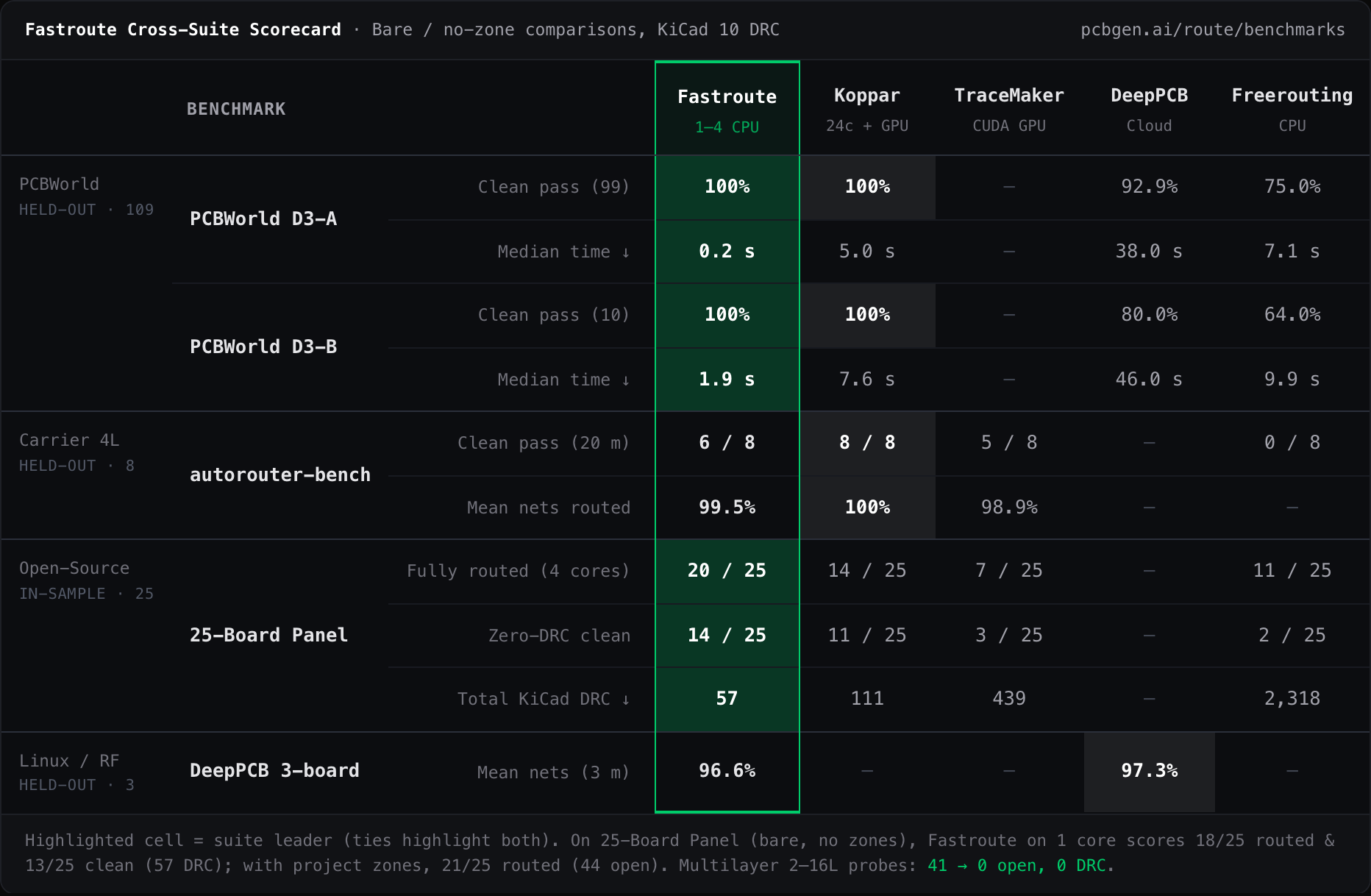
| Benchmark | Fastroute1–4 CPU | Koppar24c + GPU | TraceMakerCUDA GPU | DeepPCBCloud | FreeroutingCPU | ||
|---|---|---|---|---|---|---|---|
| PCBWorldHeld-out · 109 | PCBWorld D3-A | Clean pass (99) | 100% | 100% | — | 92.9% | 75.0% |
| Median time ↓ | 0.2 s | 5.0 s | — | 38.0 s | 7.1 s | ||
| PCBWorld D3-B | Clean pass (10) | 100% | 100% | — | 80.0% | 64.0% | |
| Median time ↓ | 1.9 s | 7.6 s | — | 46.0 s | 9.9 s | ||
| Carrier 4LHeld-out · 8 | autorouter-bench | Clean pass (20 m) | 6 / 8 | 8 / 8 | 5 / 8 | — | 0 / 8 |
| Mean nets routed | 99.5% | 100% | 98.9% | — | — | ||
| Open-SourceIn-sample · 25 | 25-Board Panel | Fully routed (4 cores) | 20 / 25 | 14 / 25 | 7 / 25 | — | 11 / 25 |
| Zero-DRC clean | 14 / 25 | 11 / 25 | 3 / 25 | — | 2 / 25 | ||
| Total KiCad DRC ↓ | 57 | 111 | 439 | — | 2,318 | ||
| Linux / RFHeld-out · 3 | DeepPCB 3-board | Mean nets (3 m) | 96.6% | — | — | 97.3% | — |
1. PCBWorld-Bench (109 Boards)
Held-out external suite99 D3-A and 10 D3-B real open-source KiCad boards rebuilt via PCBWorld's guide chain (tracks and vias stripped, pours kept). Graded with absolute KiCad 10.0.6 DRC: a clean pass requires 0 unconnected nets and 0 DRC errors. Fastroute ran on 1 CPU core (Nov 2026 release) and cleared all 109 boards in 63.0 s total router time.
▸Inspect all 10 D3-B boards & the Nov 6 → Nov 9 paired control check 10/10 clean · 20.7 s total
On our earlier Nov 6 build, Fastroute scored 96/99 on D3-A and 9/10
on D3-B: four boards (0004, 0035, 0077, and cat-trainer)
hit the time limit. A clearance fix on the Nov 9 build moved all four boards to clean in
0.1–5.4 s; re-running the Nov 6 build on the same test machine reproduced all four
misses verbatim (3, 2, 11, and 29 open airwires at timeout), confirming the gain.
| D3-B Board | Layers | Airwires | Open | DRC | Vias | Time |
|---|---|---|---|---|---|---|
| 0113_maytal_Maytal | 2 | 20 | 0 | 0 | 10 | 0.5 s |
| 0144_ottawa-badge-tagger-2016 | 2 | 30 | 0 | 0 | 16 | 0.2 s |
| 0174_sensorboard_DiffIR | 2 | 32 | 0 | 0 | 11 | 0.5 s |
| 0203_MOD-MPU9150 | 2 | 38 | 0 | 0 | 17 | 1.2 s |
| 0232_ATTiny461DevBoard | 2 | 38 | 0 | 0 | 11 | 1.8 s |
| 0260_NiMH-Charger | 2 | 45 | 0 | 0 | 17 | 3.3 s |
| 0288_raspberrypi-3-usb-hub | 2 | 56 | 0 | 0 | 24 | 2.0 s |
| 0316_kicad-workshop_fancyboard | 2 | 55 | 0 | 0 | 23 | 2.1 s |
| 0344_mavbridge_mavbridge | 2 | 64 | 0 | 0 | 34 | 3.7 s |
| 0376_cat-trainer_teensy_base_pcb | 2 | 67 | 0 | 0 | 19 | 5.4 s |
| Total D3-B (10 boards) | 2L | 445 | 0 | 0 | 182 | 20.7 s |
2. 25 Open-Source KiCad Hardware Boards
In-sample tuning panelTwenty-five real public GitHub KiCad designs spanning 2 to 8 copper layers and 52 to 1,843 airwires (ECP5 & Kintex FPGAs, HackRF Pro SDR, STM32H7 SODIMM, Buildbotics CNC, EmberOne, RP2350/RP2040). Bare / no existing zones deletes all 350 designer zones and uses through-vias only (like-for-like with Koppar's zone-less run; tested on Nov 27 cloud CPUs at both 1 core and 4 cores); With zones keeps each board's defined copper zones and stackup via rules.
open airwires · bottom = total KiCad DRC errors · runtime
0 open / 0 DRC = clean pass
| Board | L | Airwires ▴ | Fastroute | Koppar | TraceMaker | Freerouting |
|---|
Upstream placements carry 57–74 baseline placement DRC errors (courtyard overlaps, footprint mask bridges) even before routing.
Nov 27 bare runs executed on cloud CPUs (GCP N2, ~1.4–1.8× slower per core than desktop Ryzen).
Koppar numbers from Koppar-AI/autorouter-bench (MIT, KiCad 10.0.4, 24 cores + RTX 5090, 20 min limit, no zones);
TraceMaker, Freerouting, and tscircuit (60 min limit) from the same public KiCad 10 benchmark archive.
3. Koppar autorouter-bench (8 Placement-Only Boards)
Held-out external suite
All tracks, vias, and copper zones are stripped; only component placement, board outline, and keepouts remain (every net, including ground, must be routed from scratch). 20-minute time limit. A clean pass requires 100% of nets routed and zero new DRC errors added over the original component placement. Fastroute ran on 4 cloud CPU cores with no GPU and no copper pours; rivals ran on Koppar's 24-core + RTX 5090 workstation.
% nets routed (and remaining open count if <100%) · bottom = new DRC errors added over placement · runtime
100% / 0 new DRC = clean pass
| Board | L | Airwires | Fastroute (4 cores) | Koppar (GPU) | TraceMaker | Freerouting | tscircuit |
|---|---|---|---|---|---|---|---|
| pic-programmer | 2 | 125 | 100% | 100% | 96.8% | 100% | 100% |
| rp2040-minimal | 2 | 150 | 100% | 100% | 100% | 86.0% | 100% |
| pico-vga | 4 | 180 | 100% | 100% | 100% | 100% | 100% |
| rk3328-som-evb | 4 | 462 | 100% | 100% | 100% | 96.5% | 100% |
| scalenode-cm4 | 4 | 446 | 100% | 100% | 100% | timeout | 99.1% |
| stmp157-som-evb | 4 | 905 | 100% | 100% | 100% | timeout | timeout |
| cm5io | 4 | 431 | 97.0% (13 open) | 100% | 94.9% | timeout | timeout |
| imx8mp-som-evb | 4 | 997 | 99.2% (8 open) | 100% | 99.3% | timeout | 100% |
| Summary (8) | 2–4L | 3,696 | 6/8 clean | 8/8 clean | 5/8 clean | 0/8 clean | 0/8 clean |
At 60 min on 4 cores, cm5io drops to 7 open (98.4%, 0 new DRC) and imx8mp-som-evb drops to 6 open (99.4%, 0 new DRC — 100% of signal nets routed, 6 grid-blocked GND pins remaining).
Release progression: 2/8 (Nov 6, 2 cores) → 4/8 (Nov 9, 2 cores) → 6/8 (Nov 27, 4 cores, 0 vias in pin pads).
4. 1-Core vs. 4-Core & Time-Limit Scaling
Same binary · Nov 27 cloud CPUSame-binary 1-core vs. 4-core runs across all 25 bare open-source boards (no existing zones, GCP N2 cloud CPUs), showing wall-clock speedup, open-airwire reduction, and how completion scales from 1 minute to 4 hours.
| Time Limit | 1 Core Routed | 1 Core Wall Sum | 4 Cores Routed | 4 Cores Wall Sum |
|---|---|---|---|---|
| 1 min | 10 / 25 | 16.3 m | 12 / 25 | 15.1 m |
| 5 min | 13 / 25 | 62.9 m | 15 / 25 | 54.2 m |
| 10 min | 15 / 25 | 114.4 m | 16 / 25 | 95.6 m |
| 20 min | 17 / 25 | 192.4 m | 18 / 25 | 161.3 m |
| 30 min | 17 / 25 | 262.4 m | 19 / 25 | 217.5 m |
| 60 min | 18 / 25 | 427.1 m | 20 / 25 | 360.6 m |
| 4 hr | — | — | 20 / 25 | 1,064.2 m |
Caveats & billing:
16 of 18 both-closed boards ran faster on 4 cores; 2 were slower (tiliqua 0.69×, bitaxe 0.82×).
Priority 4-core runs never ship worse than 1 core on the same seed; a ≥4× speedup costs less than 1 core, while a 1.7× speedup uses ~2.3× core-seconds.
5. DeepPCB's 3 Open Boards & 2–16 Layer Stackups
DeepPCB's three public mixed-signal and Linux boards (3-minute limit, 4 CPU cores, KiCad 10.0.6 DRC) alongside native 2–16 layer regression probes verifying inner-layer routing, per-net layer constraints, and deep-via barriers.
| Board | Airwires | Fastroute | DeepPCB* | Quilter* |
|---|---|---|---|---|
| strf | 100 | 97.0% | 99% | 94% |
| pocketbeagle | 296 | 96.3% | 96% | 82% |
| beagleconnect | 431 | 96.5% | 97% | 87% |
| Mean (3/3) | 827 | 96.6% | 97.3% | 87.7% |
*DeepPCB & Quilter from deeppcb.ai (2026-04-20, completion only; no DRC published; STRF had its RF front end pre-routed in DeepPCB's case study whereas Fastroute routed all 100 airwires).
On 1 core, Fastroute scores 95.8% mean across all 3 boards (0 shorts, +5 starved_thermal DRC).
| Stackup | Open | DRC | Router | End-to-End |
|---|---|---|---|---|
| 2 layers | 3 → 0 | 0 | 0.08 s | 1.94 s |
| 4 layers | 5 → 0 | 0 | 0.37 s | 2.29 s |
| 6 layers | 7 → 0 | 0 | 0.70 s | 2.56 s |
| 8 layers | 9 → 0 | 0 | 0.84 s | 2.74 s |
| 16 layers | 17 → 0 | 0 | 1.92 s | 3.77 s |
| 10 probes | 41 → 0 | 0 | 3.90 s | 13.31 s |
Synthetic capability probes (per-layer routing constraints and deep-via barriers across inner layers), native KiCad DRC verified. Demonstrates stackup support — not a claim of dense 16-layer BGA speed.
6. Routing Constraints by Router
Public docs · Nov 2026The benchmark suites above grade connectivity and KiCad 10 DRC only — not signal integrity, controlled impedance, crosstalk, or thermal limits. Here is which routing constraints each benchmarked autorouter enforces natively today, versus which nets must still be pre-routed and locked manually.
| Router | Width & Clearance |
Keep Pre-Routed |
Blind / Microvias |
Diff Pairs |
Length Match |
Impedance | Crosstalk / Thermal |
|---|---|---|---|---|---|---|---|
| Fastroute | Yes | Yes | Yes | No | No | No | No |
| Koppar | Yes | Yes | Unlisted | Yes | Partial | No | No |
| TraceMaker | Yes | Yes | No | Yes | Yes | No | Partial |
| DeepPCB | Yes | Yes | Yes | Yes | Partial | Partial | No |
| Quilter | Yes | Yes | No | Yes | Yes | Yes | Partial |
| Freerouting | Yes | Yes | Partial | No | No | No | No |
| tscircuit | Yes | Partial | Partial | Partial | Yes | Partial | No |
Enterprise EDA: Full impedance solving, delay tuning, crosstalk spacing, and thermal/ampacity sign-off live in enterprise suites (Cadence Allegro/Sigrity, Siemens Xpedition, Altium Designer), typically via constraint-driven interactive routing rather than push-button autorouting. Entries reflect public vendor documentation and repositories as of Nov 2026.
7. Where Fastroute Loses Today
Known gaps & caveats
-
Dense zone-less carrier boards (Section 3): Fastroute
clears 6/8 on 4 CPU cores, trailing only Koppar (8/8 on 24 cores + RTX 5090);
cm5ioand 6 grid-blocked GND pins onimx8mp-som-evbremain open. -
In-sample tuning (Section 2): The 25 open-source hardware boards were
used during development; treat PCBWorld-Bench and Koppar
autorouter-benchas the held-out read on unseen layouts. -
Boards without copper zones: Defining power planes and stackup vias in KiCad before routing
cuts open airwires on 6–8 layer boards (
ECP5 DC-SCM,HackRF Pro,RP2350). - High-speed SI, RF, and power nets (Section 6): Pre-route critical nets in KiCad and select Copper: Keep under Board options so Fastroute routes around them, then review before fabrication.
Pass rules & hardware:
Every Fastroute result is graded with stock KiCad 10.0.6 DRC (error severity).
A clean pass requires 0 open airwires and 0 DRC errors (absolute on PCBWorld and the 25 Open-Source Boards; 0 new errors over the original placement on Koppar autorouter-bench and DeepPCB's 3 boards, matching Koppar's scoring).
Fastroute ran on 1–4 CPU cores with no GPU; Koppar and TraceMaker ran on Koppar's 24-core + RTX 5090 workstation, so runtimes across machines are not directly comparable.
Benchmark it on your own KiCad board
Free shared queue ($0, full .kicad_pcb + JLCPCB Gerbers) or Priority Credits up to 4 cores & 4 hours.